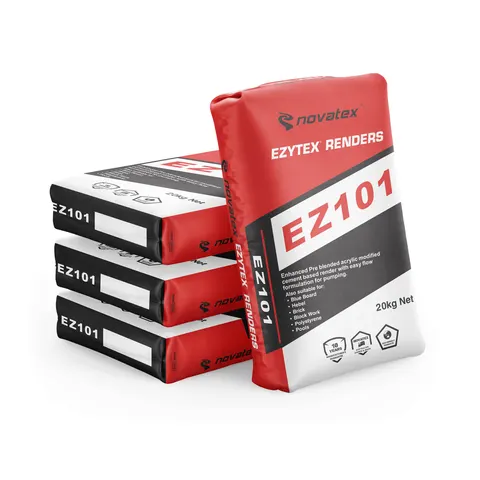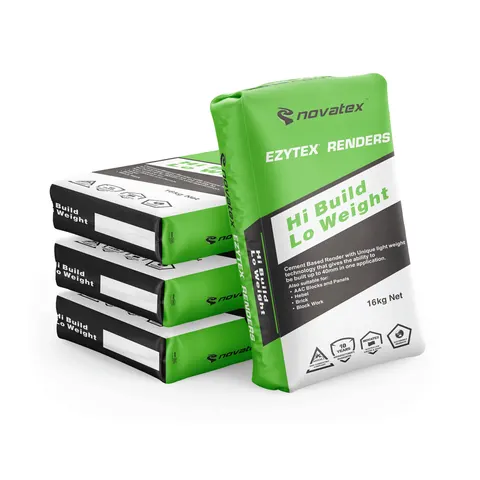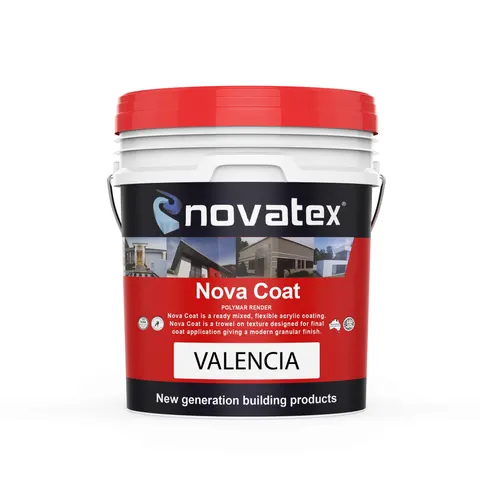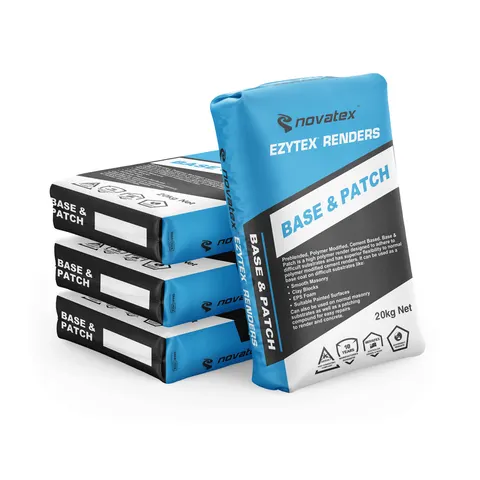
Novatex

4 products
Base coats, top coats and texture finishes in both cement and acrylic systems, in the grain sizes and finishes commonly specified on Sydney residential and commercial work.
The base coat does the structural work — it fills, levels and carries the reinforcing mesh. The top coat provides the finished texture and the weather face. Applying a texture coat directly to a poorly prepared substrate without a base coat is the usual reason a render job looks patchy and starts to craze within a year.
Texture depends on grain size, application pressure and how the surface is worked. Keep the same applicator on a wall face, work to natural breaks such as corners and joints rather than stopping mid-wall, and mix consistently between batches. A visible join in the middle of a wall face cannot be fixed without redoing the whole face.
Grain size changes both the look and the practical performance of a finish. Fine grains give a smooth, contemporary appearance but show every imperfection in the substrate beneath. Coarser grains hide substrate variation and are more forgiving on a wall that is not perfectly flat, at the cost of a heavier look and more surface to collect dirt. On large elevations, a medium grain is usually the safe compromise.
Coloured through-render varies between production batches, and that variation shows badly across a single elevation. Order the full quantity for a wall face in one delivery, check batch numbers on arrival, and box-mix across batches if there is any doubt. Where a top-up is unavoidable, plan the join at a corner or control joint rather than in the middle of a wall.
Yes. Allow the full cure time — commonly 28 days for cement render — before painting, and use a paint system rated for the alkalinity of fresh render.
Usually it dried too fast rather than curing, or the mix was too rich in cement. Both cause shrinkage cracking at the surface.
Typically a base coat with mesh and then a texture top coat. Some systems add a levelling coat between the two on uneven substrates.